
pag. 48 italian
pag. 49 italian
pag. 50 italian

THE ENCLOSED CD
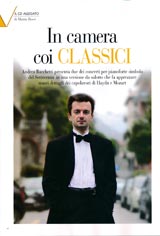
In the "Chamber"
with the CLASSICS
Andrea Bacchetti presents two iconic 18th-century piano concertos in a salon version that brings out new details in Haydn and Mozart's masterpieces
Andrea Bacchetti on piano, accompanied by the Busoni Chamber Orchestra conducted by Massimo Belli, is the star of the unreleased CD included in the May issue of Classic Voice, featuring two famous concertos by Haydn and Mozart. Born in 1977, he won his first piano competition (the "Soliva" in Casale Monferrato, Italy) at the age of 9, made his debut in Milan at 11, and quickly followed with an international career. A passionate interpreter of Bach - undoubtedly among the best around - Bacchetti's pianism is pure, intense, and magnetic.
Maestro Bacchetti, Haydn's Piano Concerto in D major is one of the most popular in his output: what
lies behind its success
«Perhaps the fact that Arturo Benedetti Michelangeli recorded it, bringing it to the attention of
the general public. It is quite short and, at the same time, very rich in musical ideas that contrast
the various characters well: the "Hungarian" style in the 3rd movement, the "lyrical"
tone in the 2nd, and the "crispness" of the 1st. I discovered it relatively late, in 2022,
but I loved it immediately, including the interplay with the orchestra».
Mozart's Piano Concerto K 488 was written during the same period as The Marriage of Figaro, but it
also holds a record: it contains the only piece Mozart ever wrote in F-sharp minor (the Adagio). What
are the other unique features of this concerto?
«Precisely, a piece written in F-sharp minor, a key notoriously known for greater technical
difficulties. And then, a grand cadenza at the end of the first allegro; the luminous yet veiled
transparency that opens up quite unprecedented expressive horizons in the central movement. I believe
K 488 is a gem, a comet among Mozart's final concertos that perhaps represents a sort of return to
the past».
What do these two substantially contemporary works have in common, and how do they differ?
«The K 488 combines virtuosity and intimacy, instrumental brilliance with melodies full of poetry
that reach the listener's heart, fascinating them and evoking a spontaneous, engaging emotion. Haydn
has been called the father of the symphony, but also the father of the string quartet. In this concerto,
I believe one can sense his formal clarity - that innovative spirit which later contributed to the
development of the sonata form. For the soloist, as well as for the conductor and the orchestra, working
on these pieces, developing their content together, and trying to get inside the minds of these geniuses
provides a powerful stimulus for endless artistic and personal growth. Every time you play it, you always
discover something new that, despite the passage of time, always feels relevant».
Both concertos are performed in Lachner's version for string orchestra: what distinguishes these
transcriptions most from the original?
«Lachner's transcriptions are more intimate versions that aim to express the composer's talent and
genius in an apparently simpler context (given the reduced ensemble) but complete without overlooking
anything - perhaps more personal. The symphonic version is made for a "large" orchestra, with
all the sound effects that come from a larger group of musicians, built precisely according to the
requirements specified by the composer».
How did you find playing with the Busoni Chamber Orchestra under the direction of Massimo Belli?
«As they say, an excellent, cohesive team that plays with enthusiasm and knowledge of the score,
picking up the ideas and thoughts of the conductor and the soloist, with whom a unity of intent is felt
immediately from the very first rehearsal. It was the same with Maestro Belli, with whom we shared a
beautiful artistic experience in great collaborative spirit and full musical harmony, which I hope to
repeat in the future».
Do you prefer playing as a soloist or in an ensemble?
«I love music in all its aspects. I remember wonderful experiences with Karajan, Berio, Orizio,
Magaloff: from Bach to the Encores. In an ensemble, you learn mutual respect with other musicians, care
for the whole, and attention to everyone's details, but also the desire to build a unique whole that is
the most authentic expression of the composer. As a soloist, while maintaining the same strict discipline,
you perhaps have slightly broader opportunities to express your own thoughts, personality, background, and
musical experience, which is not tied to the presence of the orchestra».
What projects are you currently working on?
«Ever since I was a child, I have had a great passion for Bach. I have played and recorded a large
part of his keyboard repertoire: from the Suites to the Partitas, the Toccatas, the Goldberg Variations,
the Concertos (in Turin, with the Rai Orchestra), and the Second Book of The Well-Tempered Clavier. After
more than two years of study, to complete the cycle, I have just finished recording the First Book. It was
an enormous task, especially when balanced with other concert demands. I have been playing it from memory
two or three times every single day for a long time to gain the necessary confidence - not just for the
recording, but to face it with peace of mind in public as well. All of this is also within the context of
programs built on the most classical tradition, including chamber and symphonic music».
You are also known to television audiences for having "demystified" the image of the stiff,
formal classical pianist, exploring other musical languages as well. Which projects have been the most
significant?
«The projects "From Bach to Morricone" or "From Bach to Chiambretti: Four Centuries
of Music on Television" enjoyed a fair amount of success. This idea stemmed from my experience on the
Mediaset networks, where I tried to bring a few snippets of classical music to the general television public.
It is an innovative and unusual project that couples a strictly "classical" section with another
where, using personal arrangements close to a jazz style, we explore great international music. It is a
format that engages the audience through my storytelling alongside the performances. Then, I like to recall
the collaboration with Dado Moroni on the project "Two Pianos One Soul" where, following a
"dialogue" between two pianos in their respective traditional fields (classical and jazz), we
join together to perform the great soundtracks that made the history of this repertoire, featuring
improvisations - always on two pianos - that take me back to my adolescence, when I used to improvise on
everything I heard, even winning the absolute first prize in the improvisation section of the Stresa piano
competition».