
Home > Music > The Twentieth Century Between Tension and Memory: Webern, Del Corno, Schnittke, and the...
Music
The Twentieth Century Between Tension and Memory: Webern, Del Corno, Schnittke, and the Rediscovery of Perosi
by Cesare Guzzardella - June 23rd, 2026

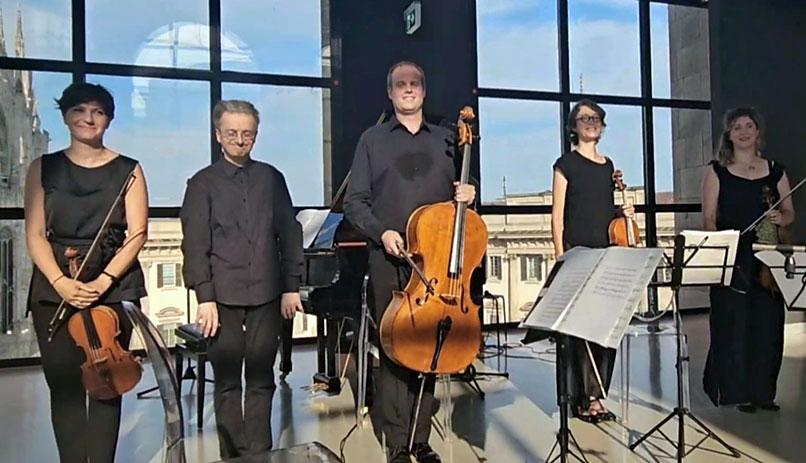
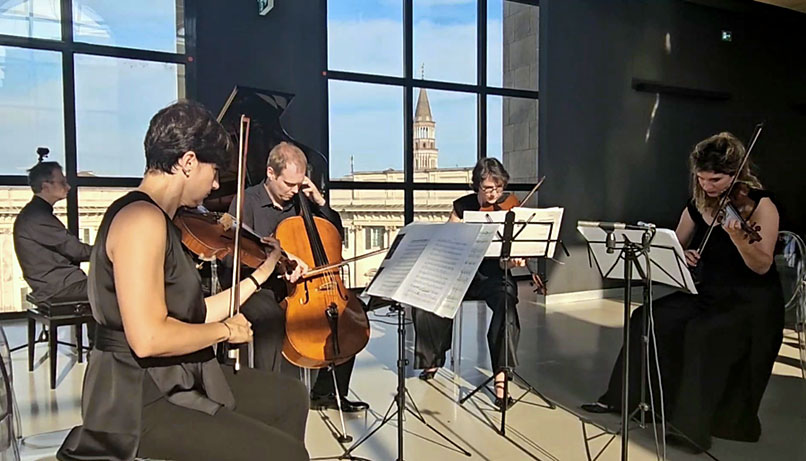
In the evocative atmosphere of the panoramic Sala Fontana at Milan's Museo del Novecento, the Itaca Quartet
- brilliant string players from the Rai National Symphony Orchestra - and the Genoese pianist Andrea Bacchetti
brought to life this afternoon a concert of rare balance. The event was part of the Suoni Trasfigurati -
Costellazioni (Transfigured Sounds - Constellations) Festival, under the eloquent title Tensioni latenti
(Latent Tensions), and was organized by the Pasquale Battista Foundation.
The program paired the expressiveness of a still-tonal Webern with the contemporary writing of Filippo Del Corno,
moving then to the existential drama of the Russian Alfred Schnittke, and concluding with two nearly forgotten pages
of Lorenzo Perosi's chamber music production.
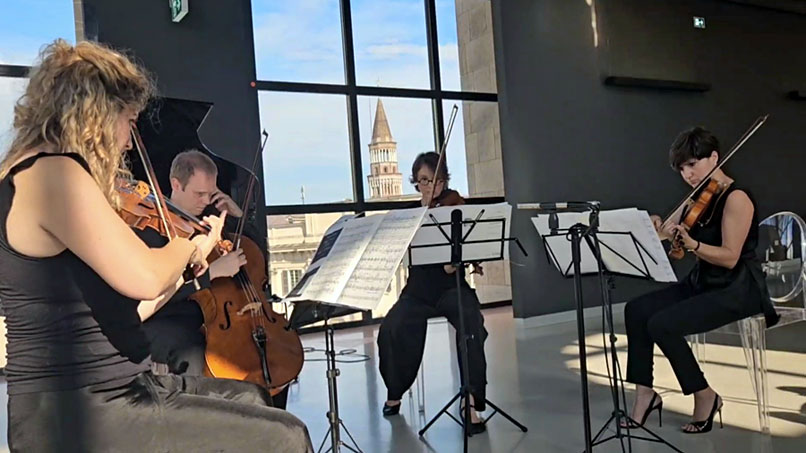
The opening with Anton Webern's Langsamer Satz immediately defined the initial atmosphere of the concert.
Far from the image of the aphoristic and austere Webern of his mature years, the young Austrian composer revealed
himself here as still immersed in a late Romanticism of remarkable lyricism. The Itaca Quartet, formed by Alice
Costamagna and Antonella D'Andrea on violins, Giorgia Cervini on viola, and Michelangiolo Mafucci on cello, enhanced
the continuity of the discourse and the softness of the timbre, revealing a cohesion of excellent interpretative
value.
Filippo Del Corno's Scherzo for String Quartet, a 2025 piece introduced by the composer himself, represented
an effective stepping stone toward the present. The agile writing, driven by a consistently controlled rhythmic
vitality, found a precise and dynamically multifaceted reading in the ensemble. The piece appeared as a luminous
interlude within a program initially dominated by more introspective atmospheres. An excellent work, detailed with
precision by the four highly talented string players.
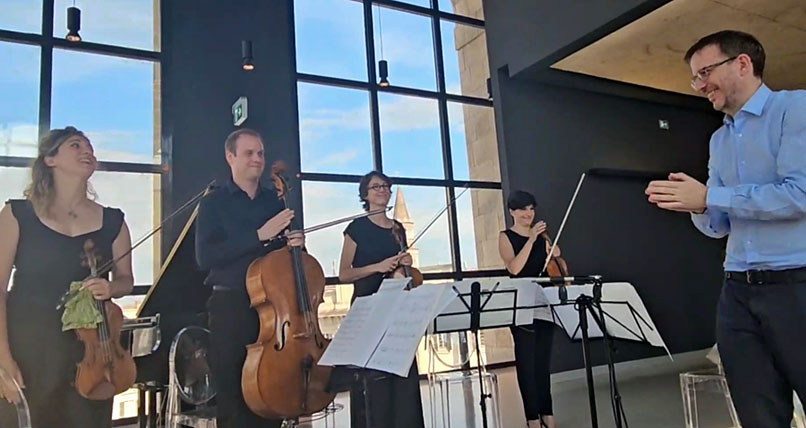
The heart of the concert was Alfred Schnittke's Quartet No. 3, one of the most emblematic works of his poetics. The opening Andante, built on references and quotations that seem to emerge from a scarred memory, was tackled with a remarkable sense of proportion. In the Agitato, the Itaca Quartet masterfully conveyed the fragmentation of the musical discourse with incisiveness, while the concluding Pesante took on the outlines of a dark and inexorable meditation. It was likely the piece that aroused the greatest emotional engagement, thanks also to the performers' ability to blend formal rigor with expressive intensity.
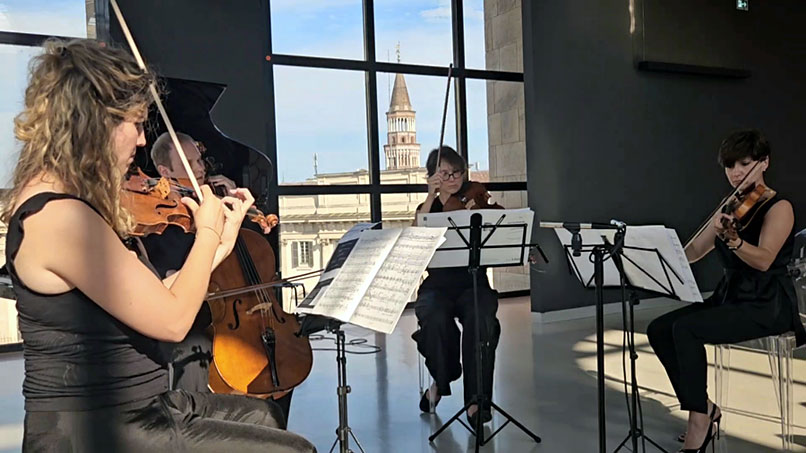
The second part was dedicated to a true rarity: Lorenzo Perosi's Piano Quintets No. 3 and No. 4. Both dating from 1931, they reveal a composer in search of sounds with a spontaneous discursive delivery and immediate emotional appeal. The Piedmontese composer's name remains chiefly linked to sacred music production, but these chamber pages reveal an author highly effective at delineating soft and delightful timbral balances. Andrea Bacchetti, a pianist well known to the Italian public, joined the dialogue with the strings without ever assuming a dominant concertante role, contributing with effective expressive delivery to restore the quality of Perosi's writing. In the Quintet No. 3 in A minor, the nobility of the central Adagio emerged above all, infused with a gathered, never rhetorical lyricism. The Quintet No. 4 in A major, probably of even greater value, showed instead a more serene and relaxed character, culminating in a finale of elegant momentum.
The journey proposed by the Itaca Quartet and Bacchetti, of extraordinary interest, prompted a reflection on the
relationship between tradition and modernity, between continuity and fracture.
Welcomed by a large and attentive audience, the event confirmed the Sala Fontana's vocation for hosting programs that
stray from more conventional paths, offering listening opportunities as stimulating as they are unusual. An afternoon
of quality music and great beauty.